


Demand Forecasting
Accurate forecasts for every item, store and channel — including the ones with no history.
Retail demand is hardest to forecast where it matters most: new items, promotions, sparse sales and short lifecycles. Dataviva picks the right method and the right history for every item, location and channel, automatically.
Forecasts are not reports. They feed allocation, replenishment, ordering and promotions directly, and update as soon as new sales arrive.
25%
Higher Sell-through
50%
Reduce Decision Time
25%
Reduce Overstocks
5%
Increase Sales
Applications

New Items, Stores and Channels
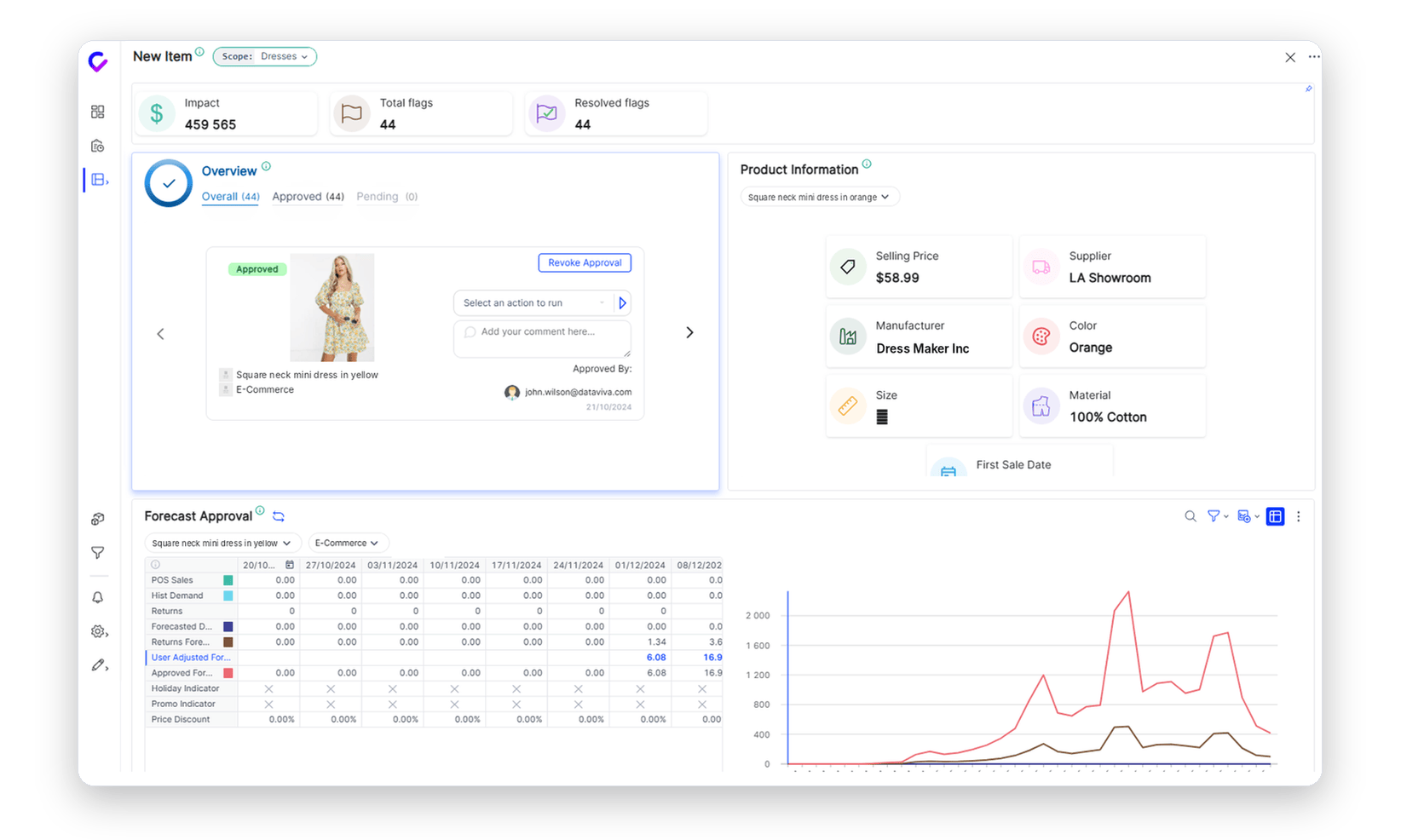
Forecasts built bottom-up from product and location attributes, down to each store and channel. For long lifecycle items, they pick up sparse demand, price and promo elasticity without additional work. For fashion and short lifecycle product, they work before you buy, for a whole collection, with no like items to pick. Forecasts feed assortment, buying and first allocation, and correct themselves continuously as real sales arrive.

Promotional Forecasting
Uplift for each promotion mechanic — price cuts, multi-buys, coupons, displays and more — alone and in combination. Halo and cannibalisation are modelled, even for promotions you have never run by grouping together history from similar promotions and similar product/locations, automatically with AI. Promotions are planned and optimised in Pricing & Promotions.

Lifecycle Phases
Every item, store and week is automatically tagged as pre-launch, launch, continuation, exit or cutoff using your existing sales, price and inventory data. Allocation and replenishment settings can follow the phase giving you fine-grained control over product tactics.

Automated Size Curves
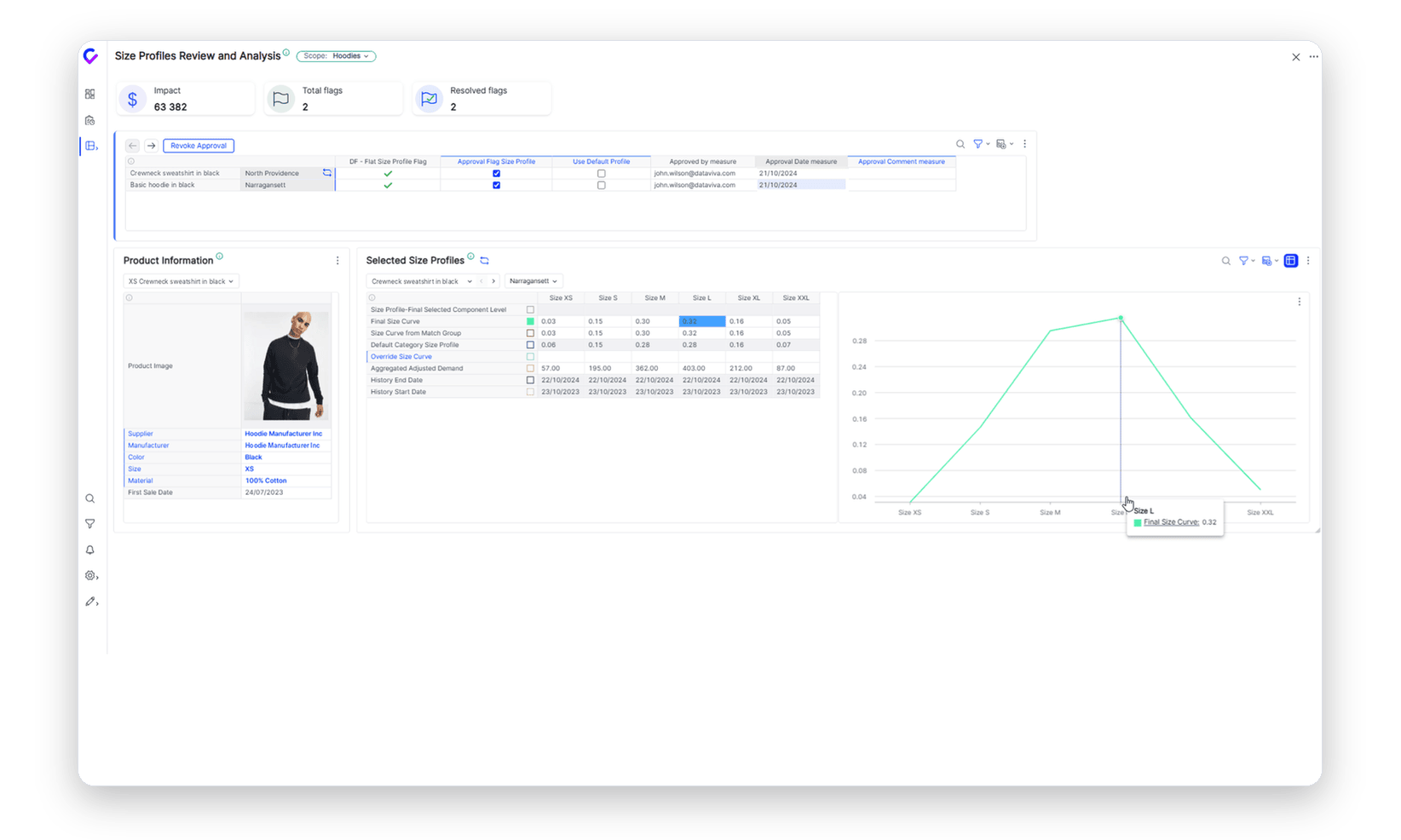
Built end to end from messy size data: size ranges and sub-ranges are found automatically, curves are calculated per store and channel, and they update as sales come in. Size issues are automatically flagged and escalated. They feed assortment and allocation and drive prepack optimization in purchasing.

Slow and Sparse Demand
Dataviva Demand Forecasting leverages machine-learning methods to accurately predict demand for very low rate-of-sale items, such as jewelry, spare parts and pharmacy lines using dynamic aggregation across product and location attributes.

Explainable by Design
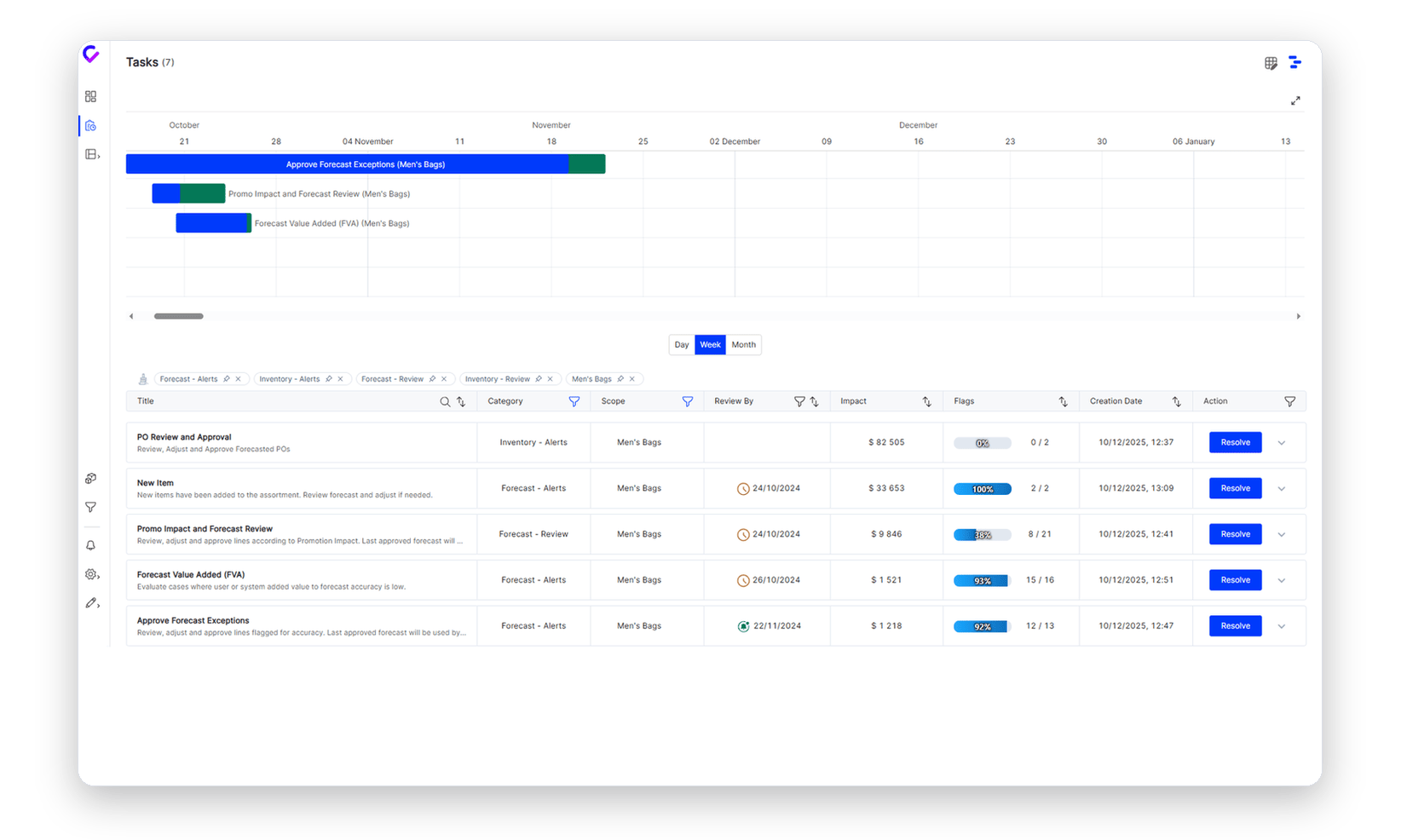
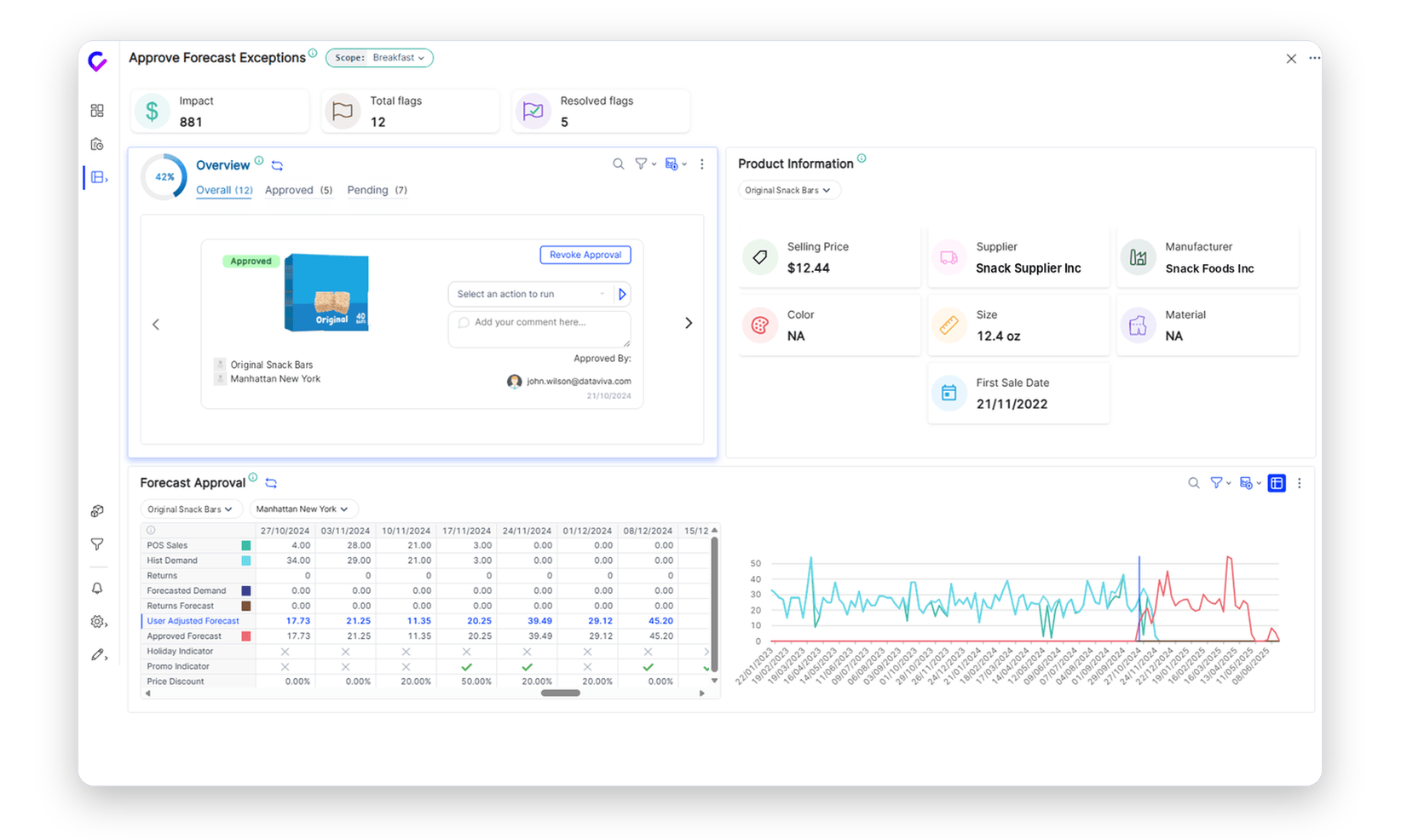
Dataviva chooses which product and location attributes drive each part of demand — rate of sale, seasonality, price response — and shows its choice. Forecasts approve themselves unless they need a look, and review goes to the lines that matter: high-margin items, traffic builders, or items where manual changes have stopped improving accuracy. Accuracy is tracked automatically, and out-of-stocks, outliers and unusual days are cleaned out of history before forecasting. The forecast also learns from its own mistakes.

Built for Tier-1 Volume
Horizontally scalable to millions of SKUs and thousands of stores, with full high availability and disaster recovery. Dataviva runs on top of your existing ERP and planning systems, so there is no rip-and-replace project.

Open to Your Data Science Team
Add your own methods using standard data science tools, call other systems in both interactive and headless processing and use forecasts as a service in any other system. See the Dataviva platform.
Case Studies

Fast Fashion Pre-Season Forecasting
Fashion, Demand Forecasting, New Products
One of Europe’s largest fast-fashion retailers places most of its seasonal buy 10 months before the season opens. Dataviva Demand Forecasting forecast a full season from pre-season history alone, including brand-new style-colors with no sales history, and landed near the best end of the fashion industry’s accuracy range.

Fashion Forecasting & Replenishment
Fashion, Demand Forecasting, Allocation, Replenishment
Clothing and General Merchandise divisions of one of Western Europe’s largest hypermarket chains with more than 1,500 stores used multiple applications to provide their forecasting models and a reactive order-point system to move inventory from warehouse to store. With the aim of cutting down on time to plan and execute and improve supply chain efficiency, the company implemented Dataviva’s Demand Forecasting and Allocation & Replenishment solutions.

Hypermarket Supply Chain
Grocery, Supply Chain
This hypermarket’s supply chain was partly managed manually and partly automated, leading to a lack of synchronization across systems and departments as well as issues in Store replenishment and Distribution Center fulfillments. With Dataviva Supply Chain solution, the company was able to boost operational efficiency, centralize and synchronize their supply chain…
Related News


Dataviva in the 2026 Gartner® Market Guide for Retail Forecasting, Allocation and Replenishment, Short Life Cycle
Gartner, Supply Chain, Retail, Inventory Planning, Forecasting
Dataviva named in the 2026 Gartner® Market Guide for Retail Forecasting, Allocation and Replenishment Solutions: Short Life Cycle Products
new
Dataviva in the 2026 Gartner® Market Guide for Retail Forecasting, Allocation and Replenishment, Long Life Cycle
Supply Chain, Retail, Inventory Planning, Forecasting, Gartner
Dataviva named in the 2026 Gartner® Market Guide for Retail Forecasting, Allocation and Replenishment Solutions: Long-Life-Cycle Products
new
AI Revolutionizes Cruise Retail: Harding+ and Dataviva Set Sail for Success
Inventory Planning, Forecasting, Cruise Retail, Retail Solutions
07 January 2025 Leading cruise retailer Harding+ and next-generation planning platform Dataviva celebrate the successful implementation of AI-driven demand forecasting and inventory management. In mid-2023, Harding+, a global leader in cruise retail, embarked on a transformative partnership with Dataviva to enhance forecasting and replenishment capabilities through advanced AI-driven solutions. This collaboration aimed to significantly improve…
newGartner does not endorse any company, vendor, product or service depicted in its publications, and does not advise technology users to select only those vendors with the highest ratings or other designation. Gartner publications consist of the opinions of Gartner’s business and technology insights organization and should not be construed as statements of fact. Gartner disclaims all warranties, expressed or implied, with respect to this publication, including any warranties of merchantability or fitness for a particular purpose.
GARTNER is a trademark of Gartner, Inc. and/or its affiliates.